
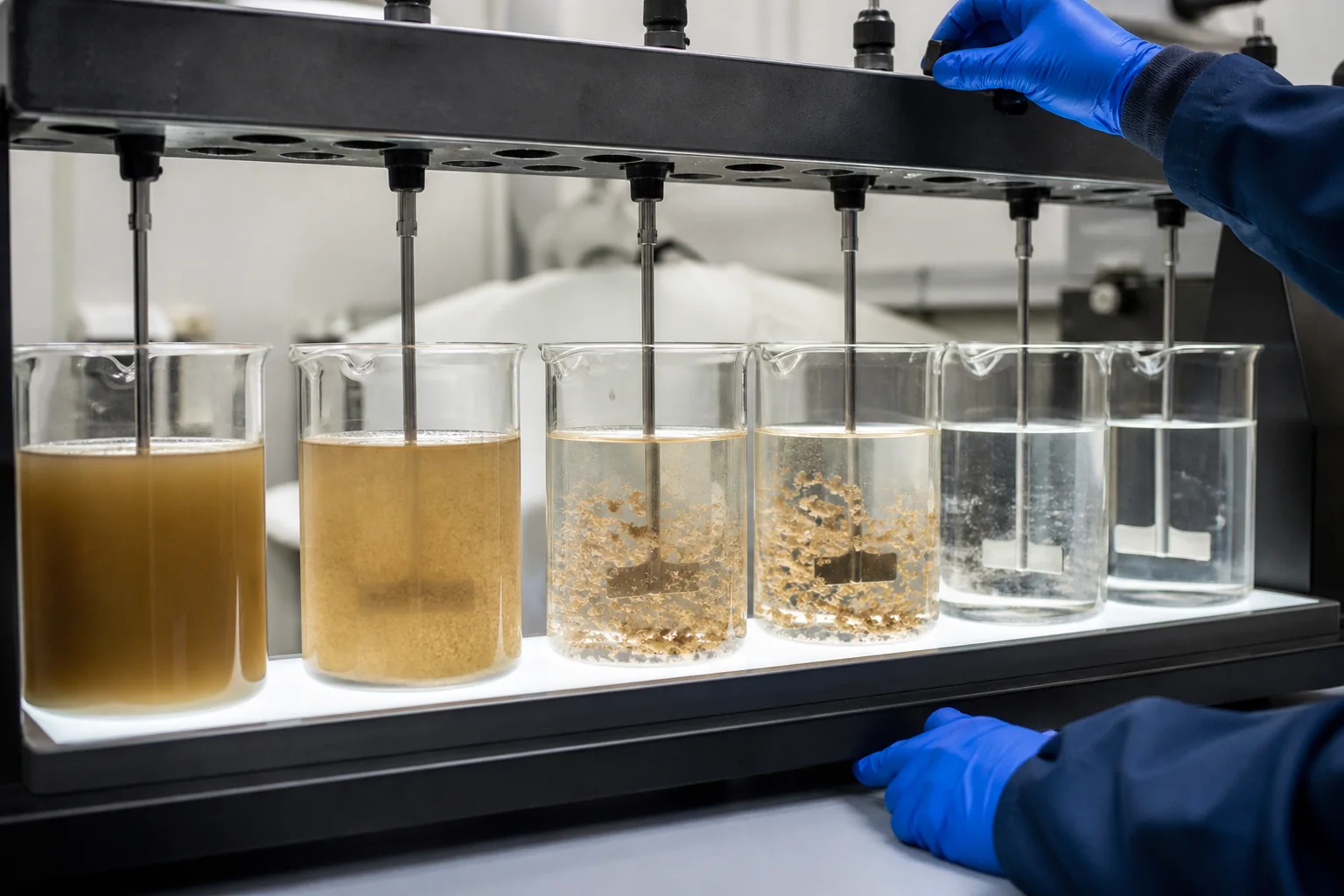
Define the operating question
State the water source, an equivalent-basis PAC versus alum comparison, target measurement and downstream separation step.
A product name alone cannot define a responsible treatment recommendation.
Characterize representative water
Record turbidity, color or target contaminant, alkalinity, pH, temperature and credible variability.
Use actual operating water rather than one convenient synthetic sample.
Normalize product and dose
Compare candidates on the same active aluminum or Al2O3 basis and document stock preparation.
Neat product units can hide differences between liquid and powder grades.
Reproduce mixing and time
Keep addition order, rapid mix, flocculation energy and settling time consistent.
A strong beaker result obtained with unrealistic mixing may not scale to the plant.
Measure the complete result
Track settled turbidity, pH, floc behavior and the application-specific analytical target.
Include sludge or filtration consequences where they control operating cost.
Release a bounded window
Link water, product code, lot, dose basis, mixing, measurements, COA, SDS and quotation.
Revalidate meaningful water, process or supplied-product changes.
Diagnose failure modes
Separate raw-water change, product identity, pump delivery, pH, rapid mixing, floc breakage and clarification loading.
Change one factor at a time when operations allow and preserve the baseline.
Close the purchasing record
State sample and trial quantity, monthly demand, packaging, destination, document needs and receiving checks.
The approved sample and production supply must remain traceable.
Compare the complete treatment cost
Compare PAC and alum only after choosing one chemical basis. Product tonnes, solution percentages and supplier dose numbers are not directly comparable. Convert both candidates to a declared active aluminum or Al2O3 basis, keep the same raw-water batch and document the conversion. Include the current plant product as a reference because an unfamiliar laboratory method can otherwise favor either chemistry unfairly.
Build matched dose ladders and record pH and alkalinity before and after treatment. PAC and alum can consume alkalinity and shift pH differently, so a turbidity comparison made at uncontrolled final pH may actually compare two different coagulation environments. If pH adjustment is part of normal operation, evaluate the chemical demand and the operational complexity together with clarification performance.
Measure the complete treatment result: floc formation, settled turbidity, color or organics where relevant, residual aluminum, sludge volume, dewatering behavior and downstream filter run. Faster visible floc is useful only when the final water and solids consequences remain acceptable. Repeat the leading conditions rather than selecting from one isolated jar.
The commercial comparison should include delivered active chemical cost, storage, dilution or dissolution, feed equipment, alkalinity correction, dose stability, sludge handling and any effect on filtration. The defensible conclusion is not that one coagulant is universally superior. It is that one candidate produced the stronger overall operating window in the tested water and process, subject to a controlled plant trial.
Confirm the comparison during a representative operating period before replacing the incumbent. Keep feed concentration, calibration, flow pacing and sampling frequency visible to both operations and the laboratory. If the preferred chemistry changes sludge production or filter loading, allow enough trial time to observe that consequence. Record the boundary conditions that would cause the plant to return to the incumbent or repeat testing.