
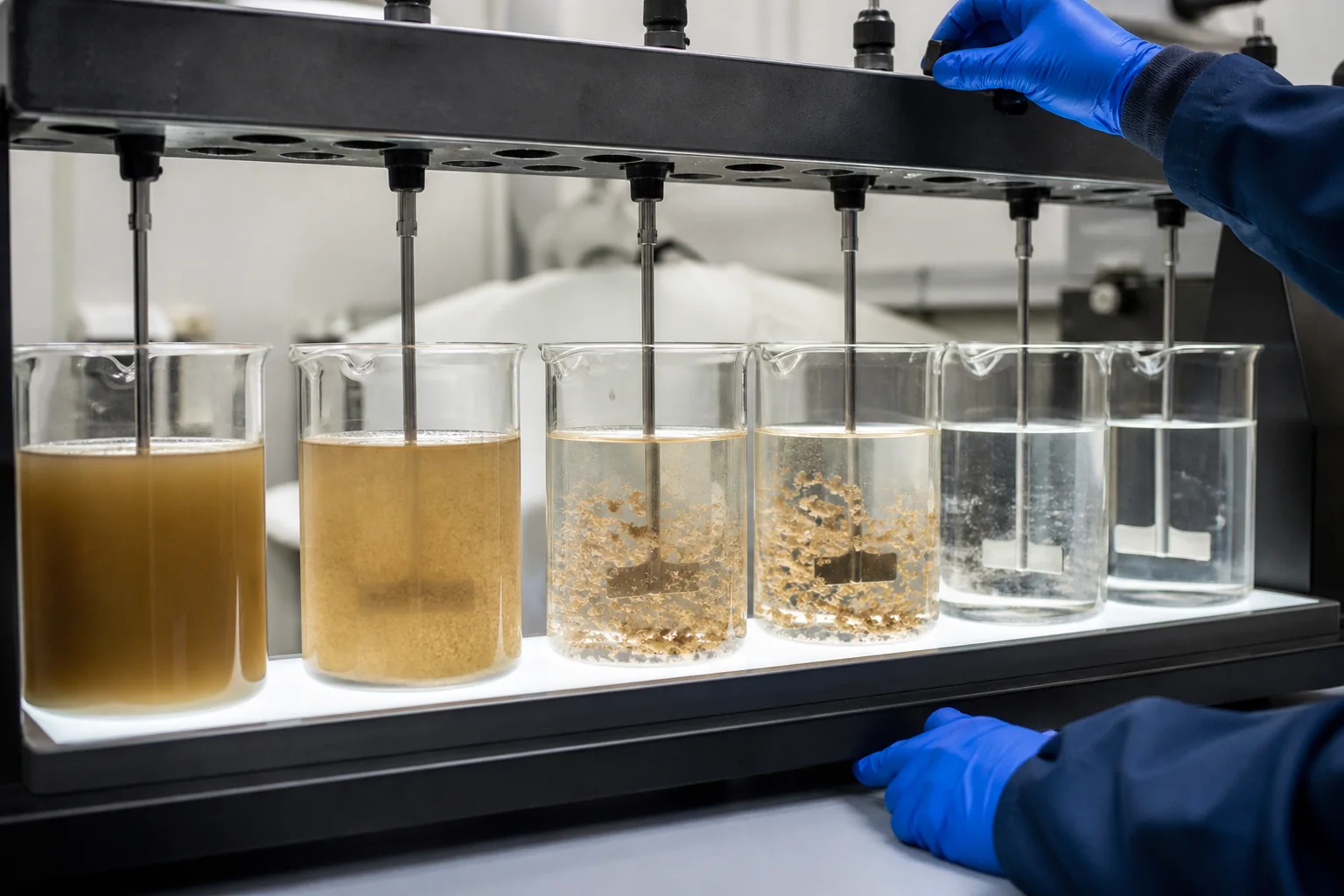
Define the operating question
State the water source, PAC basicity selection, target measurement and downstream separation step.
A product name alone cannot define a responsible treatment recommendation.
Characterize representative water
Record turbidity, color or target contaminant, alkalinity, pH, temperature and credible variability.
Use actual operating water rather than one convenient synthetic sample.
Normalize product and dose
Compare candidates on the same active aluminum or Al2O3 basis and document stock preparation.
Neat product units can hide differences between liquid and powder grades.
Reproduce mixing and time
Keep addition order, rapid mix, flocculation energy and settling time consistent.
A strong beaker result obtained with unrealistic mixing may not scale to the plant.
Measure the complete result
Track settled turbidity, pH, floc behavior and the application-specific analytical target.
Include sludge or filtration consequences where they control operating cost.
Release a bounded window
Link water, product code, lot, dose basis, mixing, measurements, COA, SDS and quotation.
Revalidate meaningful water, process or supplied-product changes.
Diagnose failure modes
Separate raw-water change, product identity, pump delivery, pH, rapid mixing, floc breakage and clarification loading.
Change one factor at a time when operations allow and preserve the baseline.
Close the purchasing record
State sample and trial quantity, monthly demand, packaging, destination, document needs and receiving checks.
The approved sample and production supply must remain traceable.
Connect basicity to the water window
Treat PAC basicity as a selection variable, not a standalone quality ranking. Begin with source-water alkalinity, pH, temperature, turbidity and organic or industrial contaminant load. The same basicity can behave differently when the water envelope or product composition changes, so a specification value cannot replace application testing.
Screen a small, coded set of PAC candidates that spans the relevant basicity range while keeping active basis, stock preparation, dose steps and mixing constant. Track final pH and alkalinity alongside floc formation and settled-water performance. This separates a true coagulation advantage from a result caused mainly by a different pH window.
Challenge the leading candidate under both normal and difficult conditions. For drinking water, that can include cold, low-turbidity or seasonally changing raw water. For industrial wastewater, include a credible contaminant and pH range. Add residual aluminum, filtration or sludge measurements when they affect release. A broad stable window is usually more useful than a narrow best point that cannot tolerate plant variability.
In the purchasing record, connect the approved sample code and lot to the stated basicity method, Al2O3 basis, relevant impurity values, COA, SDS and jar-test evidence. Ask the supplier to disclose material formulation or specification changes. Revalidate when water chemistry, treatment sequence or supplied identity changes instead of assuming the original basicity decision remains transferable.
Avoid treating basicity labels from different suppliers as interchangeable without checking the reported method and complete specification. Request coded samples and compare them blindly where practical. If two grades perform similarly, favor the candidate with the more stable dose and pH window, workable preparation and traceable supply. Preserve the rejected conditions as well as the accepted point so later troubleshooting has a meaningful baseline.