
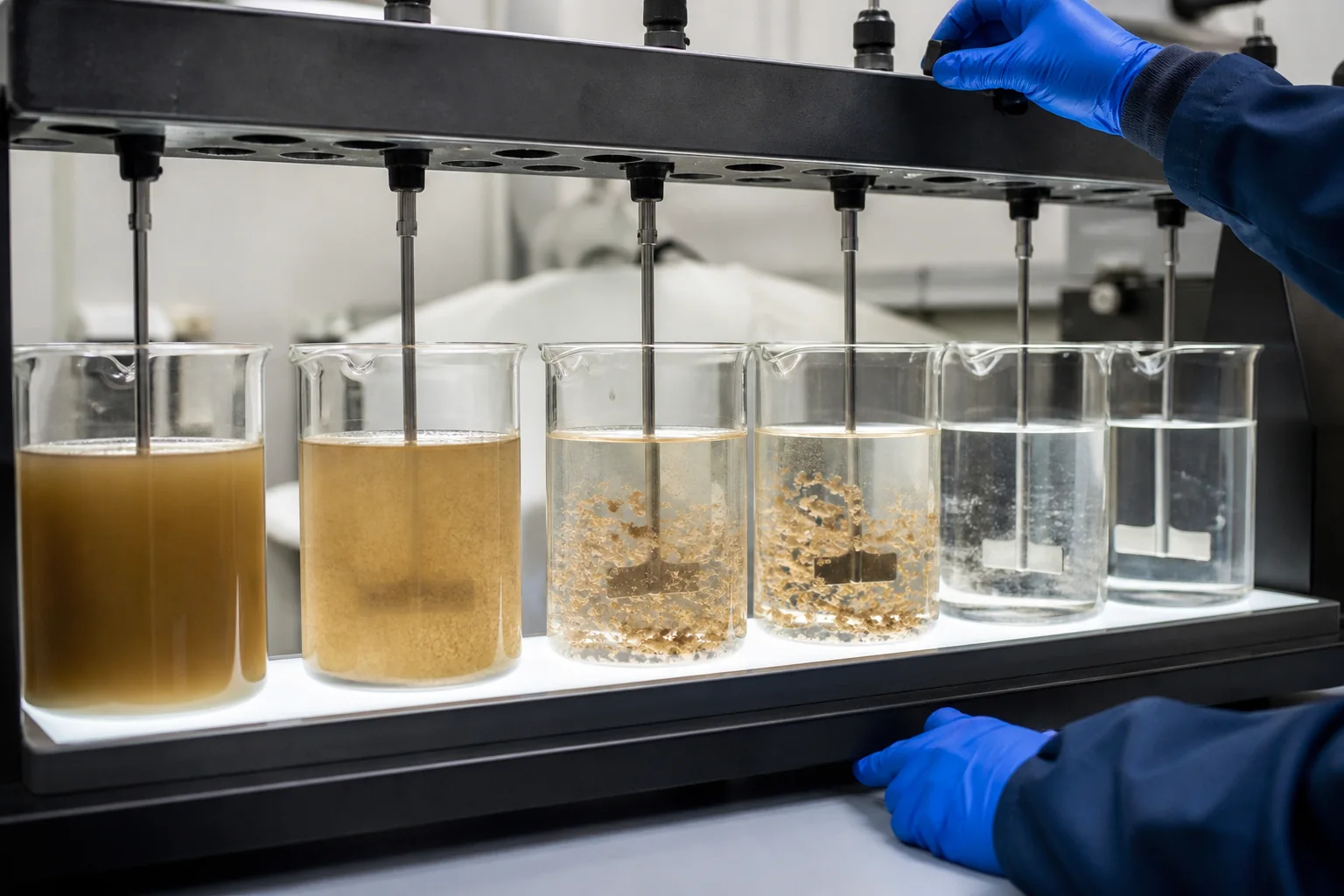
Choose the decision the trial must answer
State the current problem, candidate identity, intended treatment route and required measurement. Separate laboratory screening, plant trial and repeat-supply approval. A successful jar test supports a trial proposal under defined conditions, not automatic authorization for unrestricted full-scale use.
The jar-test guide should preserve the initial evidence. The responsible plant team must authorize operating conditions, safety controls and any changes affecting drinking water, discharge or downstream equipment.
Estimate material from the trial scope
Use planned water volume, an agreed bounded trial-dose range and the schedule to estimate product needs. Include justified commissioning and repeat requirements without converting the estimate into a universal dose recommendation. Keep sample, trial and monthly demand distinct.
Confirm pack format, unloading, storage, make-down or metering capacity and lot segregation before ordering. A trial cannot resolve product suitability if the delivered material cannot be handled or its actual consumption cannot be measured.
Keep a meaningful baseline
Record water source, quality, temperature, flow, current chemicals, pH correction and separator condition during the comparison. Select stable intervals that reflect normal operation and note unavoidable production or raw-water changes.
Compare candidate and incumbent at equivalent acceptance outcomes rather than unrelated best moments. Define the sampling points and timing so a grab sample taken before the process stabilizes does not control the purchasing conclusion.
Calibrate feed and follow the process
Verify supplied-product concentration or density, stock preparation and pump delivery. Keep the dose basis the same as the accepted laboratory method. A commanded litres-per-hour value is not evidence of delivered chemical when calibration, concentration or suction changes.
Follow rapid mix, flocculation and the actual clarifier, DAF or filter. Include final pH, treated-water and relevant solids measurements. A jar-test optimum can change at plant scale because hydraulics and solids loading are not fully reproduced in a beaker.
Define pass, conditional pass and stop conditions
Agree the performance window, monitoring frequency, deviation response and authorized reviewer in advance. Preserve the ability to stop a trial under the plant's safe operating procedure. Supplier comparison must not override the operator's responsibilities.
Conditional acceptance should identify the necessary control or evidence still pending. Record uncertainty instead of removing inconvenient intervals. If the water changes materially, the correct outcome may be an inconclusive comparison requiring another controlled test.
Release the purchase with evidence
Retain product code, lot, water envelope, actual consumption, preparation, final pH, separation results, cost assumptions and approval. Connect the accepted sample to the proposed production supply and define which changes trigger review.
Send the planned trial scope and quantities through the PAC trial-order enquiry. Use the first-lot checklist before repeat orders so a successful trial remains connected to an identifiable receiving standard.
Prepare a decision-ready trial summary
Use one summary linking the candidate lot, operating dates, stable comparison intervals, water data, calibrated consumption and agreed water/solids results. Mark deviations and unresolved observations rather than remove them from the record.
State who authorized technical release and whether the approval is unconditional within the tested envelope or still depends on a follow-up check. Purchasing can then distinguish a successful controlled trial from an encouraging but incomplete operating observation.