
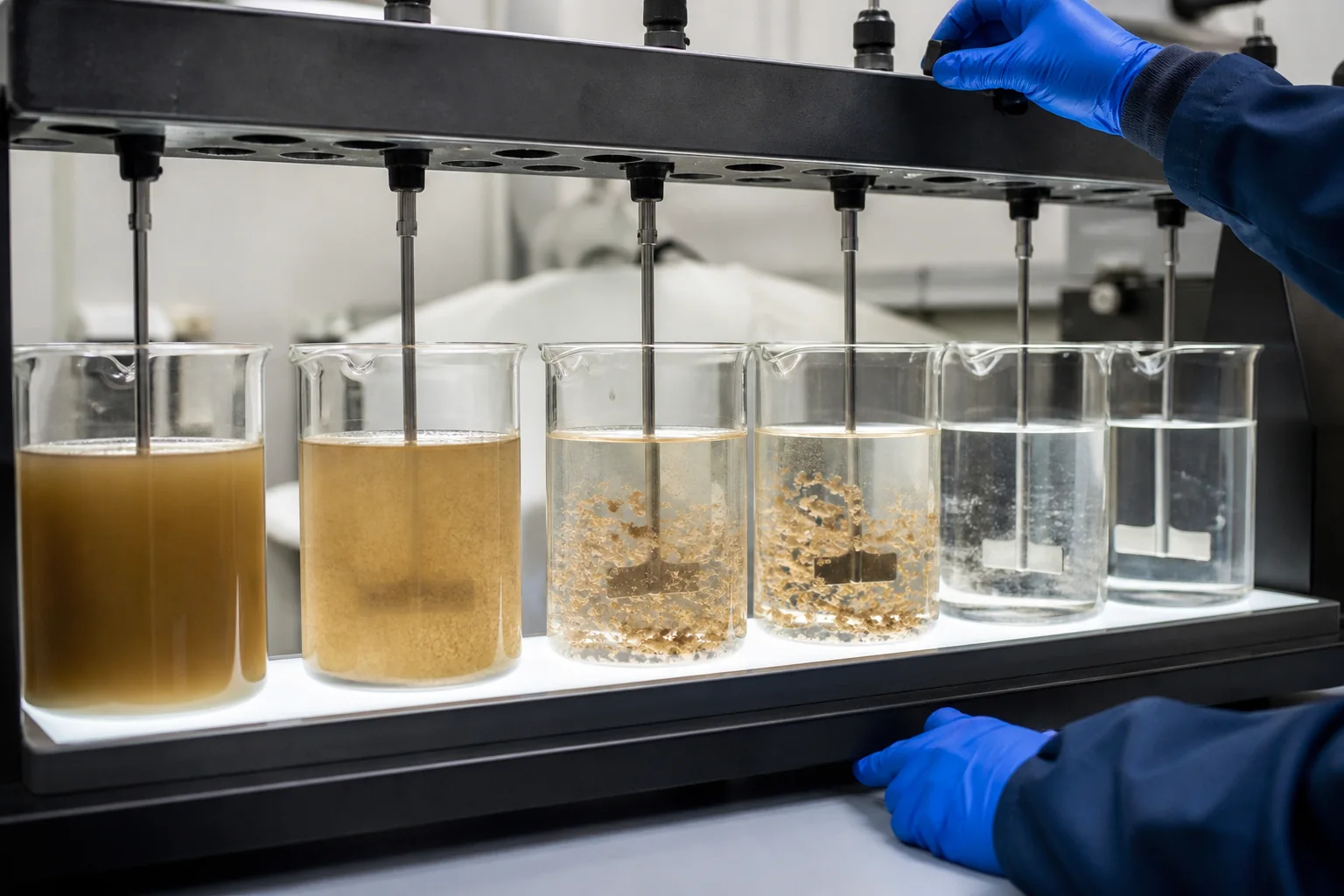
Preserve the actual cold condition
Record water temperature during sampling, preparation, mixing and reading.
Laboratory warming can create a response that cannot be reproduced in winter operation.
Record collision and buffering context
Include initial turbidity, alkalinity, pH and plant residence times.
Low particle concentration and limited mixing opportunity should remain visible in the comparison.
Screen feasible candidates
Compare a small basicity panel with the incumbent on a declared aluminum basis.
A higher dose or basicity alone is not an automatic solution to a hydraulic limitation.
Measure clarification and filtration
Observe floc development at matched times and retain final pH and relevant residual controls.
Where filter response governs release, a settling observation alone is insufficient.
Define seasonal review triggers
Preserve the accepted cold-water envelope, product identity and preparation method.
Repeat the comparison after meaningful source, temperature, treatment or hydraulic changes.
Carry the treatment evidence into purchasing
Keep water analysis, product identity, preparation, final pH, mixing and separation results attached to the buying decision. Resolve the relevant next questions with High-Basicity PAC Purchasing: Specify the Acceptance Window; PAC for Low-Alkalinity Water: What to Include in a Quote Request; PAC Trial Order: Set Plant Acceptance Before Bulk Purchase.
A technically accepted candidate still needs an identifiable supply scope, current product documents and a feasible delivery and receiving plan. Record any conditions still pending. Changes in formulation, water source, production state or treatment equipment should trigger review rather than automatically inherit an earlier approval.