
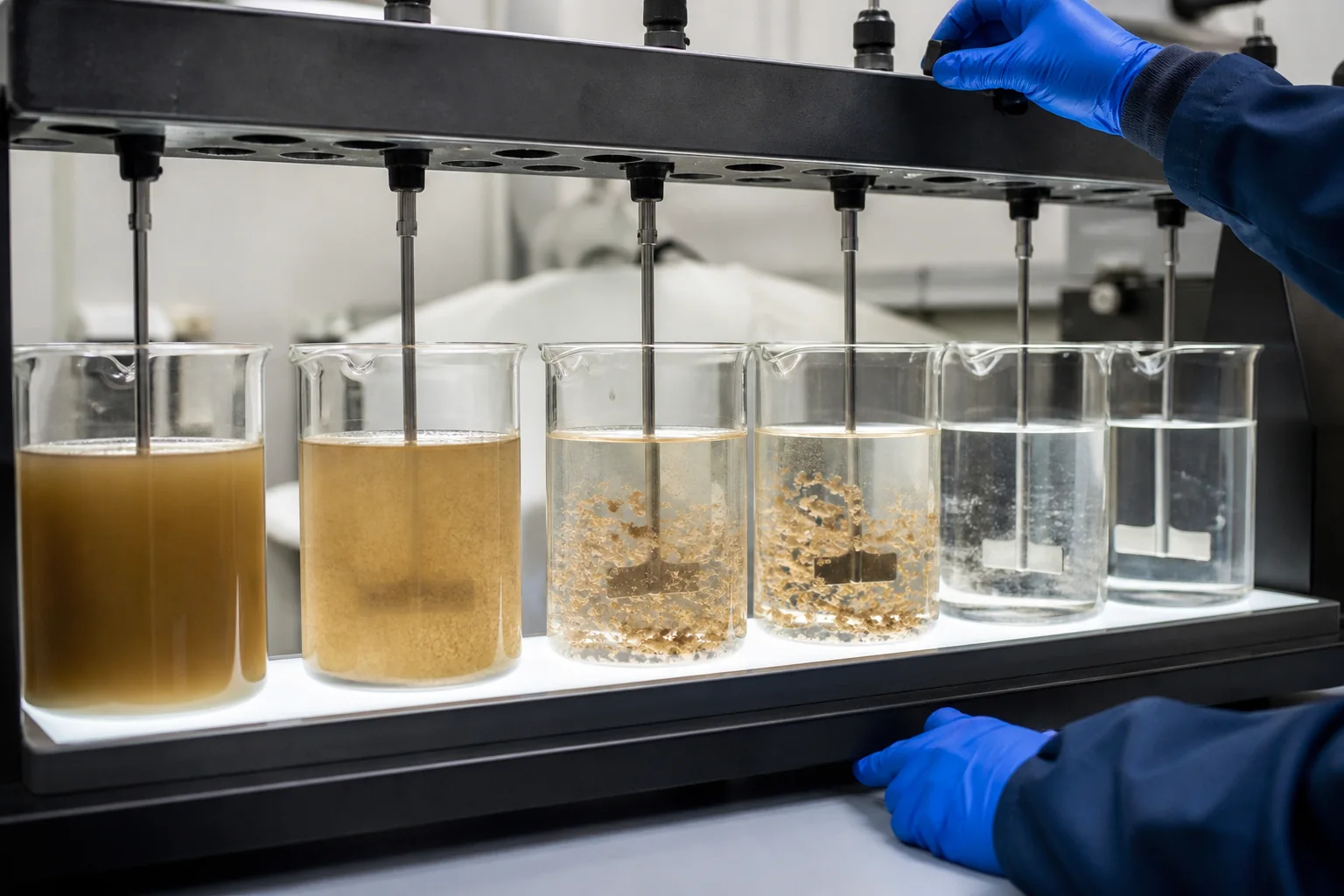
Define the reason for screening
Identify the water condition and current limitation before choosing a high-basicity candidate.
Basicity is a selection attribute, not a standalone ranking of product quality.
Record the water envelope
Include alkalinity, pH, temperature, turbidity and the target contaminant or organics context.
Test normal and credible difficult conditions instead of generalizing from a convenient average.
Control the aluminum comparison
Keep supplied-product and normalized aluminum additions explicit and identify each formulation.
Different concentration or basicity methods must be clarified before offers are treated as equivalent.
Measure the whole operating result
Record final pH, clarification and relevant residual or downstream filter response at plant-feasible mixing times.
A high basicity declaration does not establish a universal dose saving or finished-water guarantee.
Preserve the accepted boundary
State grade, method, water, preparation and treatment window with the supply identity.
Review material or process changes and keep unresolved qualification requirements visible.
Carry the treatment evidence into purchasing
Keep water analysis, product identity, preparation, final pH, mixing and separation results attached to the buying decision. Resolve the relevant next questions with High-Basicity PAC Purchasing: Specify the Acceptance Window; PAC for Low-Alkalinity Water: What to Include in a Quote Request; Drinking-Water PAC: Verify Grade Eligibility Before Ordering.
A technically accepted candidate still needs an identifiable supply scope, current product documents and a feasible delivery and receiving plan. Record any conditions still pending. Changes in formulation, water source, production state or treatment equipment should trigger review rather than automatically inherit an earlier approval.