Treat the number as an offer to verify
A request for 30% Al2O3 PAC powder identifies a desired assay, not a complete grade or a statement that a particular product is available. Confirm whether the value is a minimum, typical result or nominal description and which method supports it. Ask for the proposed product code and application scope.
Do not interpret the percentage as elemental aluminum, basicity or purity. Use the Al2O3 specification checklist to align the reporting basis before comparing suppliers or calculating the dilution needed for a test.
Check the basicity and water fit
Ask for the declared basicity and method along with the assay. High aluminum content does not establish performance in low-alkalinity water, industrial effluent or a cold clarification process. Compare the proposed powder in representative water using the same final pH and mixing controls as the incumbent.
A single content target can exclude a suitable grade or admit an unsuitable one when the process question is ignored. Keep the treatment measurement and credible water variability visible in the specification instead of assuming a nominal powder concentration defines the operating result.
Qualify dissolution with installed equipment
Describe make-down water, intended concentration, mixing, tank arrangement and withdrawal rate. Follow grade-specific instructions and verify preparation at the expected temperature. A laboratory solution made by a different procedure may hide incomplete dissolution or handling limitations in the production system.
Record insoluble residue with a defined method where relevant to tanks, lines and injection equipment. PAC powder preparation is not PAM chain hydration; do not transfer polymer-aging instructions to a metal-salt coagulant without reviewing the actual product guidance.
Compare on usable treatment value
Normalize price by the declared assay where helpful, then compare demonstrated product consumption and handling cost. Include make-down water, equipment, labour, waste and any pH correction or sludge consequences that have been measured. A higher-content powder is not automatically cheaper per accepted water volume.
The powder product evaluation should retain the process conditions behind the comparison. Test enough points to identify a controllable response window rather than select a single attractive beaker.
Protect the purchase identity
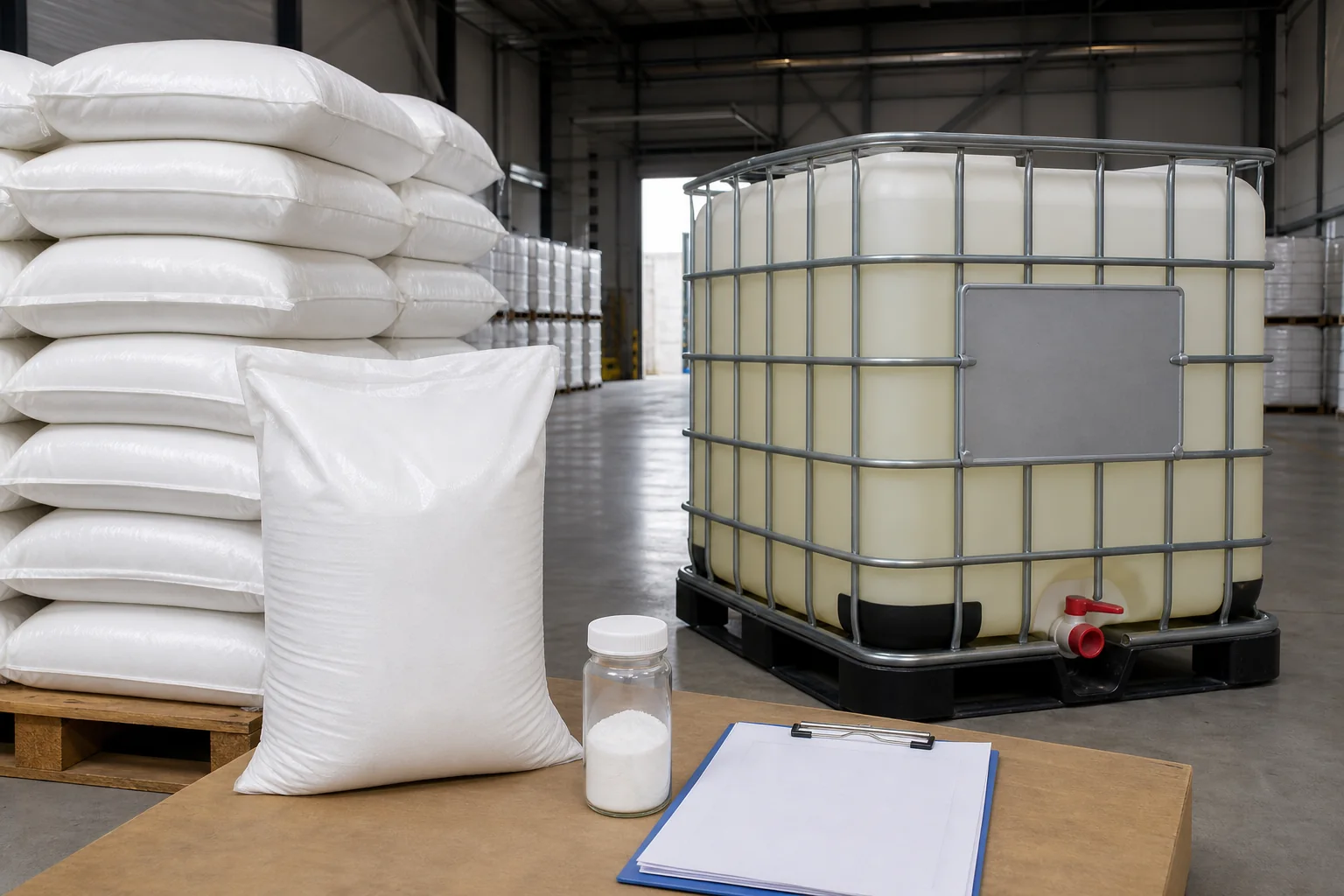
Request a lot-linked COA and applicable SDS, preparation guidance, bag specification and storage conditions. Confirm how bags and pallets will be marked and how different lots remain traceable. Moisture exposure or damaged packaging may affect use even when the printed product description is unchanged.
Do not infer drinking-water approval from white or pale powder, a high assay or a generic certificate. Any application-specific qualification must be checked for the exact offered product and the receiving requirements before purchasing.
Ask for a complete powder offer
Send the requested assay basis, application, water analysis, make-down arrangement, sample and trial needs, destination and packing requirements. Ask the supplier to identify any difference between the requested specification and the proposed grade.
Use the PAC powder enquiry for a bounded response. Confirm any requested 30% assay for the exact proposed grade. A specification request does not establish available stock, product approval or a universal quality standard.
Request a practical powder comparison pack
Ask for sufficient labelled powder to repeat make-down and the decisive treatment conditions, with the current preparation guidance. Keep a sealed portion where feasible so an abnormal receiving result can be compared without relying only on photographs.
List assay, basicity, residue method, bag condition and dissolution observations with the sample code. A grade should not be accepted because its nominal concentration matches the request while the actual preparation or treatment remains unverified.